

You may have read that retail investors are about to get direct access to the stock exchange. The coverage in June carried a fair amount of excitement, some of it suggesting ordinary investors would soon trade on the same terms as institutions.
Two things are worth knowing before you get attached to that idea. It has not happened yet, and if it does, it will change less than the headlines implied.
This explains what direct market access is, what has been proposed, and why the honest answer for most people is that it makes very little difference.
What direct market access actually means
When you place an order today, it leaves your app, passes through your broker’s systems where it is checked against your funds and their risk rules, and goes on to the exchange. That is already electronic and already fast.
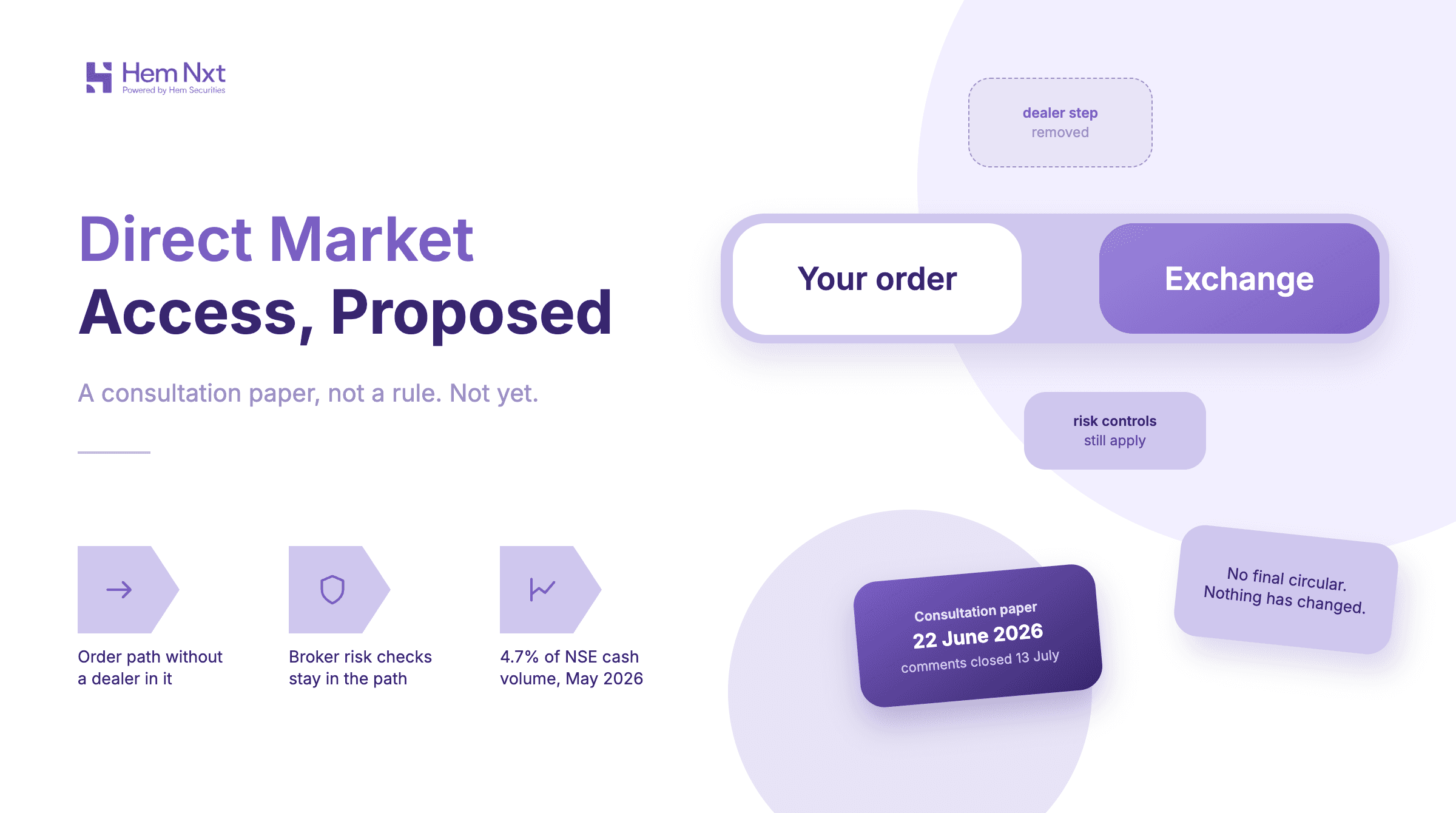
Direct market access is a specific arrangement where an order reaches the exchange without passing through a dealer at the broker’s end. The broker’s infrastructure and risk controls still sit in the path. What is removed is manual intervention.
The benefits are real and they are narrow: lower latency, more control over how an order is worked, and the ability to run systematic strategies without a person in the loop.
It has been available in India for years, and used almost entirely by institutions: mutual funds, insurers, foreign portfolio investors and large trading firms. In the NSE cash market it accounted for about 4.7 per cent of activity in May 2026, which was a nine month high.
What has been proposed
In its 22 June 2026 consultation paper on draft trading-software and technology circulars, SEBI published draft text deleting the sentence “Currently, this facility is available for institutional clients” from the DMA section.
That is genuinely the substance of it. One sentence deleted, leaving exchanges free to extend the facility to whichever categories of investor they consider appropriate, subject to the risk management controls applying to each.
The regulator’s reasoning is that trading systems and risk management tools have improved enough since the framework was written that the original concerns no longer justify the restriction.
Two related proposals sit alongside it. Direct market access in commodity derivatives, permitted for foreign portfolio investors since May 2023, would be opened more widely. And the technology rules for exchanges, clearing corporations and depositories would be consolidated and modernised, including stronger authentication and cybersecurity requirements.
Public comments closed on 13 July 2026. At the time of writing there is no final circular, so nothing has changed. Treat any coverage that describes this as done with caution, and check for a circular before acting on it.
What it would actually change for you
Less than the framing suggests, and it is worth being direct about why.
Your orders already reach the exchange electronically. Nobody is manually keying in your trade today. The dealer intervention that direct access removes is not part of an ordinary retail order path.
Latency is not your constraint. The advantage of shaving milliseconds accrues to strategies competing on speed. If you are buying shares to hold, or even trading intraday by hand, the time your order spends in transit is not what determines your result.
Broker risk controls remain. This is stated explicitly in the proposal. Your available funds, margin requirements and the broker’s own limits still apply. Direct access is not unmediated access.
The proposal itself does not change securities transaction tax, stamp duty, exchange charges or GST.
For most investors, the practical difference would likely be small.
Who it would genuinely help
There is a real beneficiary group, and identifying it clarifies what the proposal is for.
Anyone running systematic or automated strategies. SEBI’s retail-algorithmic-trading framework became applicable to all stock brokers from 1 April 2026. That framework governs retail algo/API access through brokers; it is distinct from DMA. If DMA eligibility is widened in a final circular, sophisticated clients may be able to use DMA subject to exchange eligibility, broker authorisation and DMA controls.
Anyone trading at size, where execution quality across a large order matters more than the price on the screen at the moment of decision.
And anyone whose strategy depends on responding quickly to conditions rather than to a decision made in advance.
That is a small proportion of retail investors, and it is the group the proposal appears designed to serve.
The part worth thinking about
Every layer between an investor and the exchange slows things down, and some of that slowness is protective.
Broker systems catch errors. They stop orders that exceed available funds and flag things that look wrong. Removing intervention makes execution faster and it also makes mistakes faster, because a badly specified order reaches the market before anyone has looked at it.
The proposal keeps risk controls in place, so this is a matter of degree rather than a removal of safeguards. But it is worth understanding that speed and protection trade against each other, and that the case for extending access rests on risk systems having improved enough to absorb the difference.
For an ordinary investor the practical conclusion follows from that. If the facility becomes available and you are offered it, the question is not whether faster is better. It is whether anything you do actually depends on speed. For most people it does not, and the additional control brings additional ways to get something wrong.
Common questions
What is direct market access?
An arrangement where an order reaches the exchange without manual intervention by a dealer at the broker, though the broker’s systems and risk controls remain in the path.
Can retail investors use DMA in India?
Not at present. The facility has been available primarily to institutional clients. SEBI has proposed removing that restriction but no final circular has been issued.
When will this take effect?
Unknown. A consultation paper was issued on 22 June 2026 and comments closed on 13 July 2026. Final rules may differ from what was proposed, and may not arrive at all.
Would DMA make my trades cheaper?
No. Statutory charges, exchange charges and GST are unaffected, and brokerage is a commercial matter for each broker.
Would it make my orders faster?
Marginally, by removing dealer intervention. For anyone not competing on execution speed, the difference is not something you would notice. The proposal keeps broker risk-management controls in place, and brokers continue to have the applicable regulatory obligations for orders routed through their systems.
How much trading currently goes through DMA?
According to NSE Market Pulse, June 2026 (reporting May 2026 data), DMA accounted for 4.7% of NSE cash-market turnover, a nine-month high. Attribute the statistic directly to NSE and specify that it is turnover share.
Should I want this?
Only if something you do depends on execution speed or automated order handling. For most investors it would change nothing worth noticing.
The short version
A consultation paper has proposed deleting one line that restricts direct market access to institutional clients. Comments have closed. No rule has been made.
If it happens, it will matter most to people running automated or size-sensitive strategies, while the practical difference for most other investors is likely to be small. The gap between what retail investors get and what institutions get has never really been about the speed of order routing, and closing this particular gap does not change that.
Risk disclosure
Hem Finlease Private Limited, SEBI Registration No. INZ000167734. Hem Securities Limited, SEBI Reg. No. IN-DP-568-2021, CDSL: 17700/17701.
Investments in the securities market are subject to market risks. Read all the related documents carefully before investing. Registration granted by SEBI and membership of recognised stock exchanges do not guarantee the performance of the intermediary or provide any assurance of returns to investors.
All Topics
