

Who gets the money?
When you buy or sell shares, the amount you pay does not all go to your broker. It is split across a few different charges.
The main ones are:
Government taxes and GST
Exchange and regulatory charges
Depository charges
Brokerage and account-related charges
The charges, one at a time
Securities Transaction Tax (STT)
STT, or Securities Transaction Tax, is a government tax charged on certain securities transactions.
For equity delivery transactions, STT is 0.1% on both the purchase and sale. For equity intraday transactions, STT is 0.025% on the sell side.
Stamp duty
Stamp duty is generally charged when you buy securities. For equity delivery transactions, the current rate is 0.015% on the buyer. For equity non-delivery transactions, such as intraday equity trades, the current rate is 0.003% on the buyer.
NSE transaction charge
The stock exchange charges a transaction fee when your trade is executed. For NSE cash-market trades, the transaction charge is ₹306.99 per crore per side from 1 March 2026.
That works out to about ₹3.07 per ₹1 lakh of traded value.
NSE IPFT contribution
NSE also collects an Investor Protection Fund Trust (IPFT) contribution on cash-market transactions. The current rate from 1 March 2026 is ₹0.01 per crore per side.
At normal retail trade sizes, this amount is extremely small. It is a useful reminder that not every line item on a contract note has a meaningful impact on your total cost.
SEBI turnover fee
SEBI also charges a small turnover fee based on transaction value. For sale and purchase transactions in securities other than debt securities, the current rate is ₹10 per crore.
GST
GST is charged on applicable service components such as brokerage and certain exchange or regulatory charges. It is not a tax on the value of the shares you buy.
Brokerage
Brokerage is simply the fee your broker charges for executing your order. Unlike statutory charges, brokerage can vary from one broker to another.
Hem Nxt currently offers an introductory brokerage of ₹10 per executed order, with standard pricing of ₹20 per order. Other applicable charges are extra.
Depository and DP charges
When you sell shares, they are debited from your demat account. Your DP may charge a DP or depository fee for that debit.
How much does a ₹1 lakh trade actually cost?
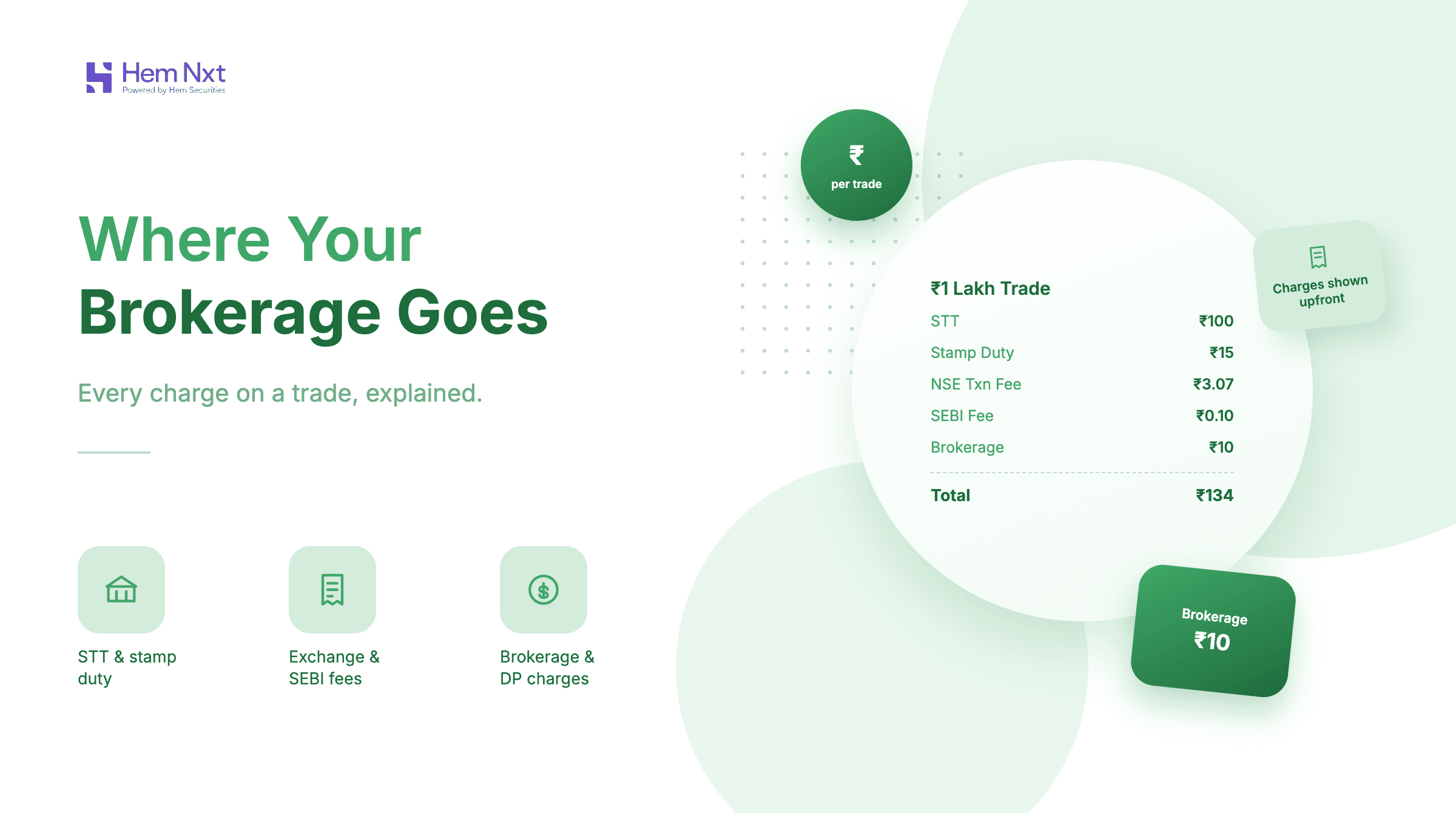
Let's make this concrete. Suppose you buy ₹1,00,000 worth of shares for delivery on the NSE and later sell them for ₹1,10,000.
The important thing to notice is that some charges are based on the transaction value, while brokerage and DP charges follow the broker's applicable tariff.
Charge | Buy | Sell | Notes |
|---|---|---|---|
STT | ₹100.00 | ₹110.00 | 0.1% of transaction value |
Stamp duty | ₹15.00 | Nil | 0.015% on buyer |
NSE transaction charge | ₹3.07 | ₹3.38 | ₹306.99/crore per side |
NSE IPFT contribution | ~₹0.00 | ~₹0.00 | ₹0.01/crore per side |
SEBI turnover fee | ₹0.10 | ₹0.11 | ₹10/crore |
Brokerage | ₹10.00 | ₹10.00 | HEM NXT tariff |
DP charge | Nil | HEM tariff | Customer-facing HEM tariff |
GST | Calculated | Calculated | Applies to applicable service components |
All DP charges are as per the DP tariff structure, which is intimated to CDSL 30 days prior to a change and once in every financial year, i.e. before 30 April.
Illustrative example: the ₹1,00,000 purchase and ₹1,10,000 sale values are used to show how each charge works. The final total should be calculated only after the applicable Hem Nxt tariff and GST treatment are confirmed.
Why the final bill is not just brokerage
Brokerage is only one part of the overall bill. Taxes, exchange charges and regulatory charges can apply even when the broker charges a low or zero brokerage fee.
Flat brokerage matters more on smaller trades because the same ₹10 or ₹20 fee takes up a larger percentage of a small trade.
For example, a ₹10 brokerage charge is 0.5% of a ₹2,000 trade, while the same ₹10 is only 0.005% of a ₹2,00,000 trade.
If you are just starting out
Many charges are determined by tax, exchange, regulatory and depository rules. When comparing brokers, focus on the charges the broker can actually control, such as brokerage, customer-facing DP charges and annual maintenance.
One important point: many transaction taxes and regulatory charges are linked to transaction value or turnover, not to whether you made a profit. So even a losing trade can still carry transaction charges.
Your contract note is the easiest place to see the charges applied to your trade.
What this post does not cover
Pledge and unpledge charges, if you pledge holdings for margin
Call and trade charges, if you place an order by phone rather than in the app
Auto square-off charges on intraday positions not closed before cut-off
Payment gateway charges on some fund transfer methods
Interest on delayed payment, if your account goes into debit
Annual maintenance charges on the demat account
Capital gains tax is separate from these trading charges. It applies to taxable capital gains rather than simply to the value of the transaction.
Common questions
What are DP charges?
DP charges are charges associated with your demat account. They may apply when shares are debited from your account, such as when you sell them. The depository's own tariff and the amount your broker or DP charges you can be separate figures.
What are AMC charges on a demat account?
AMC, or Annual Maintenance Charge, is the fee for maintaining your demat account. Some investors may qualify for a Basic Services Demat Account (BSDA), where different AMC rules can apply.
Is zero brokerage really zero cost?
No. "Zero brokerage" means the broker does not charge brokerage under the applicable plan or transaction conditions. Other costs, such as STT, stamp duty, exchange and regulatory charges, GST and applicable DP charges, can still apply.
What does one intraday trade actually cost?
An intraday trade can cost differently from a delivery trade because STT, stamp duty and other charges depend on the type of transaction. Brokerage and GST may also apply.
Why is my total different from another broker's?
Your total can differ from another broker's because brokerage, customer-facing DP charges and annual maintenance can differ. Some other charges are set by the applicable tax, exchange or regulatory rules.
The simplest way to compare brokers
The simplest way to compare brokers is to separate the charges you cannot control from the ones you can. Taxes and most regulatory charges follow the applicable rules. Brokerage, customer-facing DP charges and AMC are among the costs that can differ between brokers.
On Hem Nxt: ₹10 per executed order (introductory) and ₹0 AMC for the first year. Other statutory charges apply.
Risk disclosure
Hem Finlease Private Limited, SEBI Registration No. INZ000167734. Hem Securities Limited, SEBI Reg. No. IN-DP-568-2021, CDSL: 17700/17701.
Investments in the securities market are subject to market risks. Read all the related documents carefully before investing. Registration granted by SEBI and membership of recognised stock exchanges do not guarantee the performance of the intermediary or provide any assurance of returns to investors.
All Topics
