

A strategy can show extraordinary returns in a backtest and still be a poor strategy to use with real money. Now imagine a retail investor who has subscribed to one. It runs automatically through their broker account. They pay a monthly fee for it. When they ask how it decides what to buy, they are told the logic is proprietary.
They pay anyway, because the results look extraordinary and the explanation sounds professional.
For years, there was no dedicated framework governing this specific kind of retail algorithmic strategy arrangement. Third parties selling such strategies often operated outside any clear accountability to the investor. As of April 2026, retail algorithmic trading operates under a formal regulatory framework.
First, what an algorithm actually is
The word does more work than it deserves.
An algorithm is a rule, written down precisely enough for a computer to follow. Buy when the price crosses this level. Sell if it falls this far. Place this order at this time each month.
That is all. Every automated strategy, from the simplest scheduled purchase to the fastest institutional system, is a set of rules executed without a human pressing the button each time.
Which means the interesting question was never whether automation is good or bad. It is who wrote the rules, whether you can see them, and who is answerable when they go wrong.
Why this needed fixing
Two things collided.
First, SEBI’s own research showed that algorithms play a major role in the profits made by some large institutional traders in India’s equity-derivatives market. For a retail trader who keeps losing money, the message can sound simple: if the professionals are using machines, maybe I should use one too.
Second, a market grew around that idea. Strategy sellers, subscription services and API-connected trading systems began offering automated strategies to retail investors. Many were promoted using impressive backtested returns. But an ordinary investor could find it difficult to understand how the strategy actually worked, how risky it was, or whether those past results were realistic.
SEBI had already recognised that retail interest in algo trading was growing and that the existing rules needed to be strengthened with additional safeguards.
So SEBI introduced a formal framework.
On February 4, 2025, SEBI issued its circular called “Safer participation of retail investors in Algorithmic trading.” The implementation timeline was later extended while brokers and other participants worked on the technology, processes and implementation standards needed to put the new rules into practice.
The change that matters most
Before: an algo provider connected to your account through your broker’s interface, and if the strategy did something catastrophic, the question of who was responsible had no clean answer.
SEBI's framework says that brokers providing algo trading are responsible for, among other things, handling investor grievances related to algo trading and monitoring APIs. It also requires a broker to conduct due diligence before onboarding an algo provider.
In simple terms, an algo provider cannot simply build a trading system and independently plug it into a broker's infrastructure. There is now a defined chain of responsibility involving the exchange, broker and algo provider.
The rule that protects you specifically
This is the one worth knowing before you ever pay for a strategy.
Strategies are sorted into two kinds.
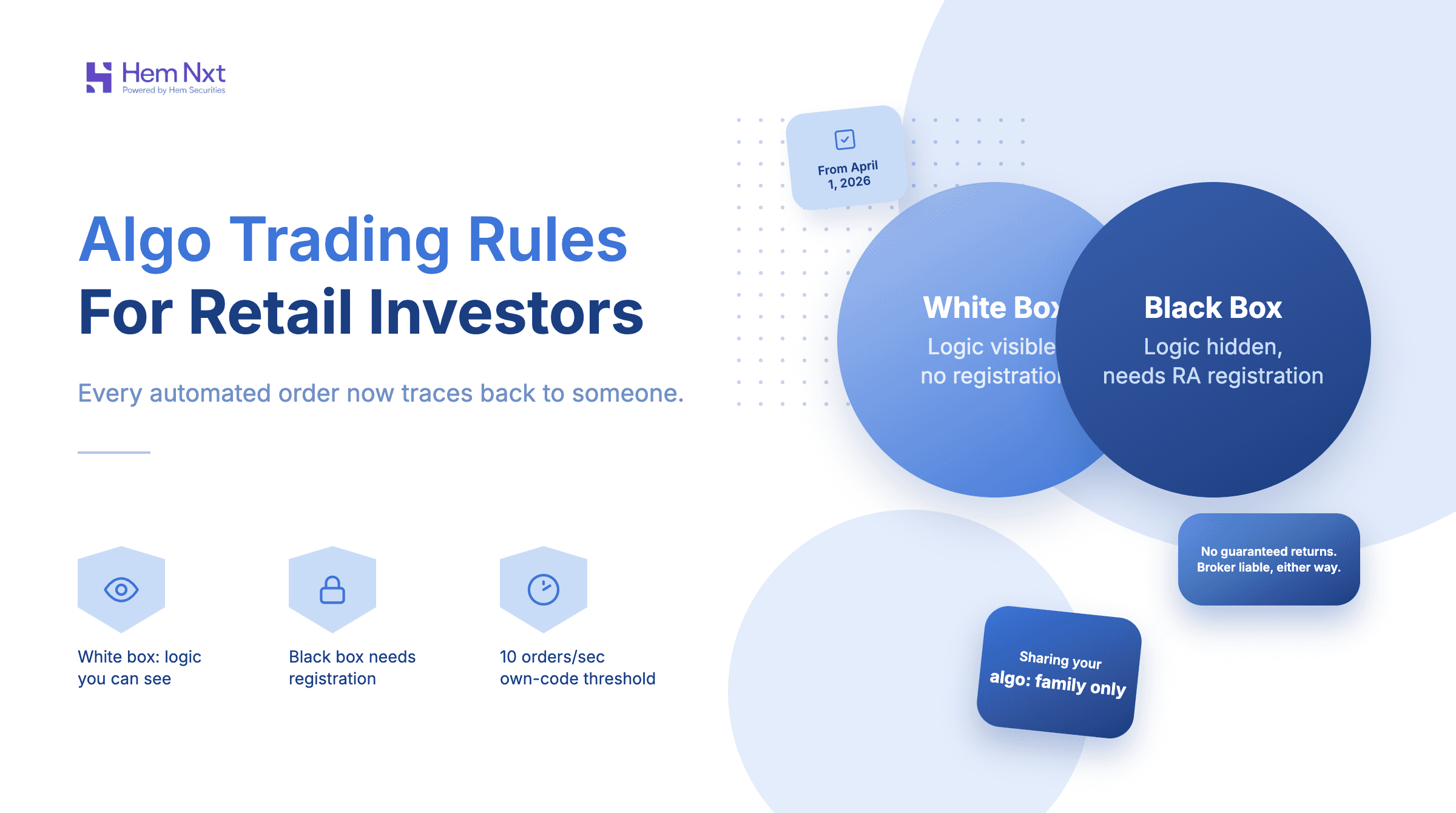
A white box algorithm has logic you can see and could reproduce yourself. Buy when the price crosses its average of the last fifty days, sell if it falls three per cent. Nothing is hidden.
A black box does not tell you how it decides. You subscribe, it runs, and the reasoning stays with the provider.
To offer a black box strategy, the provider must hold a research analyst registration from SEBI. They must also maintain a detailed research report for each such strategy, and if the logic changes, it has to be registered again as a new strategy.
So the sentence “the logic is proprietary” is now a regulatory statement rather than a marketing one. If someone says it and holds no registration, they are not protecting a trade secret. They are describing an arrangement they are not permitted to sell you.
Two more things follow from this, and both are worth knowing before you pay anyone.
Black box providers must be SEBI-registered research analysts, and SEBI asks investors to report any research analyst offering assured or guaranteed returns. Any strategy sold on that basis should be treated as a red flag, whatever the backtest says.
And where a broker takes a share of what you pay the provider, that arrangement has to be disclosed. If your broker recommends a strategy, you should be able to see what you are paying and how the relevant charges are structured.
The provision that closes an obvious loophole
If you build your own algo and register it, it may be used for your own family. Specifically yourself, your spouse, your dependent children and your dependent parents.
Not friends. Not a group. Not for a fee.
It is a small clause and it is aimed at something real. The natural next step for anyone with a working strategy is to run it for other people, at which point they are managing money for others without any of the registration that ordinarily requires. The family limit permits the reasonable case and closes the rest.
What did not happen
Algorithmic trading was not banned. That was widely reported at the time and it was wrong.
Personal automation remains available. API access continues, now through a unique key tied to your provider and a static internet address registered with your broker, so that every order can be traced to a person and a machine. Open access endpoints are closed, and authentication has been tightened.
What ended is the unaccountable middle: strategies sold to the public by people who were not registered, could not be identified, disclosed nothing, and answered to nobody.
Before you buy an automated strategy
Five questions, in order of how much trouble they save. Then one to put to your broker.
Can you explain how it decides? If not, ask for the research analyst registration. No registration and no explanation means walk away.
Is the provider empanelled, and the strategy approved? Both are required for anything sold to you. Your broker can confirm it and now has a direct reason to know.
Does your broker earn from it? Revenue sharing between broker and provider must be disclosed. Ask.
What does the backtest actually show? A strategy tuned until it performs beautifully on past data is trivially easy to produce and tells you almost nothing about the future. Ask what period it covers and whether it includes a bad one.
What are the costs on the strategy’s own trading pattern? An active strategy can incur transaction taxes, brokerage and exchange-related charges repeatedly as it trades. Costs that look negligible per trade are not negligible across thousands.
Ask your broker what responsibility it assumes for automated orders executed through its platform under the applicable framework. That is worth knowing before you need it rather than after.
The honest position
Automation does not confer an edge by itself. It executes a rule faster and more consistently than a human. If the rule is bad, automation applies a bad rule with great discipline.
The institutional advantage identified in SEBI’s data is not the existence of algorithms. It is the research, capital, infrastructure and risk systems behind them. Buying a subscription does not import any of that.
What the framework provides is a floor: identifiable providers, accountable brokers, traceable orders, and a rule that stops anyone selling you something they refuse to describe. That is a genuine improvement on what existed before, and it is not a substitute for the strategy being any good.
Common questions
Has algo trading been banned in India?
No. It has been brought under a formal framework requiring identification of strategies, accountability from brokers and registration of certain providers. Personal automation remains available.
Do I need to register my own trading script?
Only if it exceeds ten orders per second on a single exchange within a second. Below that you are treated as a normal user of your broker’s interface. Note this applies to code you write yourself. A strategy you buy from someone else needs exchange approval regardless of how fast it trades.
What is the difference between a white box and a black box algo?
A white box has logic you can see and reproduce. A black box does not disclose how it decides, and offering one requires the provider to hold a SEBI research analyst registration.
Can an algo provider promise me returns?
No. Black box providers must be SEBI-registered research analysts, and SEBI asks investors to report any research analyst offering assured or guaranteed returns.
Who is accountable for algo trading on a broker's platform?
Your broker is the principal and the algo provider acts as its agent. The broker is responsible for handling investor grievances related to algo trading and for monitoring APIs.
Can I run my algo for friends?
No. An algo you have built and registered yourself may be used for yourself, your spouse, your dependent children and your dependent parents only.
Why do I need a static IP for API access?
So that automated orders can be traced to a specific user and provider. API access is issued through a unique key tied to a registered address rather than left open.
Does using an algo improve my results?
It applies your rule consistently and quickly. It does not make the rule correct, and it does not supply the research and infrastructure behind institutional systems.
When did the rules take effect?
The circular was issued in February 2025 and was due to apply from 1 August 2025. Implementation was deferred twice, with a phased rollout from 1 October 2025, and the full framework applied to all brokers from 1 April 2026.
The short version
Automation was never the problem. Unaccountable automation was.
The framework identifies who wrote the strategy, makes your broker answerable for it, traces every order back to its source, and stops anyone selling you a strategy they will not explain. Ask how it works, and if the answer is that you cannot know, you now have a rule on your side rather than just a bad feeling.
Risk disclosure
Hem Finlease Private Limited, SEBI Registration No. INZ000167734. Hem Securities Limited, SEBI Reg. No. IN-DP-568-2021, CDSL: 17700/17701.
Investments in the securities market are subject to market risks. Read all the related documents carefully before investing. Registration granted by SEBI and membership of recognised stock exchanges do not guarantee the performance of the intermediary or provide any assurance of returns to investors.
All Topics
